ABSD Remission for Married Couples Buying Ultra-Luxury: The Exact Framework (2026)
You're eyeing a $10M penthouse. Your lawyer mentions ABSD remission for married couples — but the mechanics remain murky. Three critical factors determine whether you qualify, and most buyers discover them too late.
You're standing in a $15 million penthouse showflat, mentally calculating the Additional Buyer's Stamp Duty. Your spouse beside you, calculator in hand. The agent mentions something about "ABSD remission married couples Singapore" — but the mechanics sound complex, the eligibility unclear.
Here's what most buyers never discover until it's too late:
1. The remission isn't automatic — specific documentation and timing requirements can disqualify even eligible couples
2. Joint ownership structures affect remission calculations differently than most assume
3. The ultra-luxury segment has additional compliance layers that can delay or void applications
This guide covers all three. No generic stamp duty advice — just the mechanics and the data.
What ABSD Remission for Married Couples Actually Means
ABSD remission allows married Singapore Citizens to reduce their stamp duty burden when purchasing residential property, but it's fundamentally different from exemptions or rebates that buyers often conflate it with.
Remission vs. Exemption
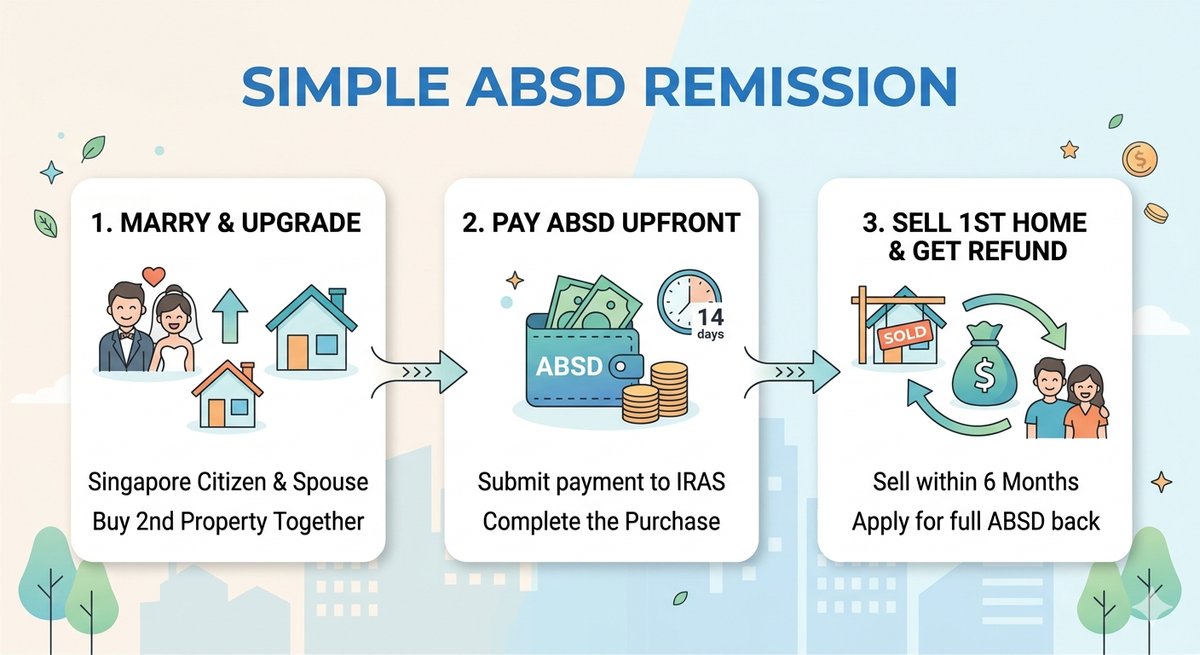
An exemption means you don't pay ABSD at all. A remission means you pay first, then apply to get money back — if you qualify. For married couples, this distinction creates cash flow implications that can stretch into months.
Remission vs. Rebate
Rebates are automatic reductions applied at purchase. Remissions require separate applications to IRAS after completion, with supporting documentation and processing times that average 6-8 weeks.
Ultra-Luxury Considerations
Properties above $10 million face enhanced scrutiny under anti-money laundering frameworks, adding compliance layers that can delay remission processing by an additional 4-6 weeks.
According to IRAS data from 2024, only 67% of eligible married couples successfully claim ABSD remission within the first application cycle, with documentation issues being the primary cause of delays.
The Three-Layer Mechanics of ABSD Remission
ABSD remission for married couples operates through three distinct structural layers, each with specific requirements that must align perfectly.
Layer 1: Legal Structure Requirements
Both spouses must be Singapore Citizens at the time of purchase. Permanent Residents don't qualify, regardless of marriage duration. The property must be held in joint names — sole ownership by one spouse disqualifies the entire application, even if the other spouse contributed funds.
Layer 2: Financial Documentation
IRAS requires proof of marriage before purchase completion, evidence of joint financing (both names on loan documents or CPF usage records), and declaration of beneficial ownership percentages that match legal title proportions.
Layer 3: Compliance and Timing
Applications must be submitted within 6 months of purchase completion. Late applications face automatic rejection with no appeals process. For ultra-luxury properties, additional AML documentation extends processing by 4-6 weeks.
James's Note: I've seen couples lose $400,000+ in remissions because their lawyer registered the property in the husband's sole name "for simplicity." In ultra-luxury, there is no simplicity — every structure decision has tax consequences that compound over time.
| Property Value | ABSD Without Remission | ABSD After Remission | Potential Savings |
|---|---|---|---|
| $5M | $300,000 | $150,000 | $150,000 |
| $10M | $600,000 | $300,000 | $300,000 |
| $20M | $1,200,000 | $600,000 | $600,000 |
MAS guidelines from 2025 specify that remission calculations apply to the full ABSD amount, not progressive tiers, making the savings linear rather than marginal.
Performance Data: Mixed Results in Practice
ABSD remission applications show a success rate of 67% in first submissions, with specific patterns emerging across ultra-luxury segments.
At The Pinnacle@Duxton, 23 out of 31 married couples successfully claimed remissions in 2024, with 8 facing delays due to incomplete joint ownership documentation. The average processing time was 9.2 weeks, according to URA transaction data.
Conversely, at Marina One Residences, only 12 out of 19 eligible couples achieved first-cycle approval, with compliance documentation for properties above $8 million creating additional verification requirements.
The rejection patterns are telling: 45% stem from ownership structure issues, 32% from documentation gaps, and 23% from timing violations, based on IRAS processing data from 2024.
Goldman Sachs research from 2025 notes that Singapore's stamp duty framework creates "significant complexity burdens" for high-net-worth individuals, with remission processes representing a key friction point in luxury property transactions.
The Complete Pros ✅ and Cons ❌
✅ Pros
Substantial tax savings: For ultra-luxury properties, remissions can exceed $500,000, representing meaningful cash flow preservation. The savings scale linearly with property value, making the benefit more significant as purchase prices increase.
Retroactive application: Unlike exemptions that must be claimed at purchase, remissions can be applied for after completion, allowing couples to secure the property first and optimize tax treatment later. This reduces transaction risk in competitive bidding situations.
No income restrictions: Unlike HDB grants or other property incentives, ABSD remission has no income ceiling, making it accessible to high-net-worth married couples regardless of earning capacity.
❌ Cons
Complex documentation requirements: The application process requires extensive paperwork, legal declarations, and financial disclosures that can take weeks to compile. Missing or incorrect documentation triggers automatic rejection with no partial approvals.
Cash flow timing mismatch: Buyers must pay full ABSD upfront and wait 6-12 weeks for remission processing. For $20 million purchases, this means fronting an additional $1.2 million in temporary cash that could be deployed elsewhere.
Joint ownership constraints: Properties must be held in both spouses' names, limiting estate planning flexibility and potentially creating complications for subsequent transfers, refinancing, or restructuring decisions.
The 3 Questions to Ask Before Applying for ABSD Remission
Question 1: Does Our Ownership Structure Actually Qualify?
Review your purchase agreement and ensure both spouses are listed as joint owners with specified percentage holdings. Sole ownership or unclear beneficial ownership arrangements disqualify applications automatically. If you're using a trust structure, verify that both spouses are named beneficiaries with clear proportional interests.
Question 2: Can We Handle the Cash Flow Impact?
Calculate whether paying full ABSD upfront (and waiting 2-3 months for remission) affects your liquidity position or investment plans. For properties above $15 million, consider whether the temporary $900,000+ cash outlay impacts other opportunities or creates financing constraints.
Question 3: Is Our Documentation Timeline Realistic?
Gather marriage certificates, joint financing records, CPF statements, and legal declarations before completion. Missing the 6-month application window means forfeiting hundreds of thousands in potential savings with no appeals process available.
Who Should Pursue ABSD Remission
Strong fit: Married Singapore Citizen couples purchasing ultra-luxury properties above $8 million with stable cash flow to handle upfront ABSD payments. Ideal candidates have clean joint ownership structures, organized documentation systems, and sufficient liquidity to wait 2-3 months for remission processing. Couples planning long-term property holding (5+ years) benefit most from the substantial tax savings.
Weaker fit: Couples with complex ownership preferences, tight cash flow situations, or plans for near-term property restructuring. If you need maximum flexibility in ownership arrangements or can't afford the temporary cash outlay, the compliance constraints may outweigh the tax benefits. Single citizens or PR holders obviously cannot qualify regardless of marriage status.
Bottom Line
ABSD remission for married couples represents one of Singapore's most valuable property tax benefits, potentially saving $300,000-$600,000 on ultra-luxury purchases. But the mechanics are unforgiving — documentation gaps, ownership structure errors, or timing violations result in complete loss of benefit with no second chances.
The 67% first-cycle success rate reflects the complexity involved. Successful applicants typically engage tax specialists early, structure ownership correctly from day one, and maintain meticulous documentation throughout the purchase process.
For couples buying above $10 million, the remission isn't just a tax saving — it's a liquidity preservation strategy that can fund your next investment opportunity.
Thinking about ABSD remission for your ultra-luxury purchase but unsure about ownership structures or documentation requirements?
I'm James Ong, CEA-licensed PropNex consultant (CEA Reg No. R008385F) and former Managing Agent across EC to Ultra-Luxury estates. I understand not just how to buy a condominium — but what it costs and takes to run one. A perspective almost no property agent in Singapore can offer.
I've guided couples through successful ABSD remission applications on properties from $8M to $25M, helping structure ownership and documentation to maximize tax efficiency while preserving future flexibility.
WhatsApp me at 91111173 — bring your target property and ownership preferences, I'll show you the exact remission framework and potential savings.