CCR Condo Losses in 2026: Is Singapore's Prime Property Market Worth Buying — Or Worth Avoiding?
CCR condos grew only 18% over 10 years vs 45% for OCR. The Clift, Marina Bay Suites and OUE Twin Peaks are recording losses — some exceeding $1M. Here's the objective data on why prime property underperforms, and whether 2026 is the year that changes.
You have probably heard the rule: Singapore property only goes up. And for most of the island, over most holding periods, that has been close enough to true to feel like fact.
But walk into the resale market for Core Central Region condominiums in 2025 and 2026, and you encounter something that disrupts that comfortable narrative. Sellers booking losses. Not small ones. Million-dollar losses, at named projects in Districts 1, 9, and 10 — the very addresses that were supposed to represent Singapore's most resilient real estate.
Three things most buyers considering prime property in Singapore never properly investigate:
- CCR condos have delivered the weakest price growth of any region over the past 10–15 years — lagging both RCR and OCR by a significant margin, regardless of how prestigious the address.
- The losses at The Clift, Marina Bay Suites, OUE Twin Peaks, and Marina One Residences are not outliers. They are the predictable outcome of a specific set of structural conditions — and those conditions have not fully resolved.
- Despite all of that, the case for selective CCR entry in 2026 is more coherent than it has been in a decade — for a specific buyer profile, at specific price points.
This guide covers all three. No cheerleading for any region — just the mechanics behind the numbers and an honest view on recovery.
The 15-Year Price Growth Divergence: What the Data Actually Shows
The single most important context for understanding CCR's current performance is the long-run price growth comparison across the three regions.
| Region | 10-Year Price Growth (Resale, 2012–2022) | 15-Year Growth (2010–2025) | Annualised |
|---|---|---|---|
| OCR | 39% | ~45% | ~2.5–3% p.a. |
| RCR | 35% | ~55% | ~3–3.5% p.a. |
| CCR | 21% | ~18% | ~1.1% p.a. |
Sources: SG Property Detective, Knight Frank analysis via Global Property Guide Q3 2025, StackedHomes resale performance data 2025
From Q3 2020 to Q3 2025 specifically — the post-pandemic recovery period when Singapore property was supposedly booming — cumulative price growth in the CCR was 27%, compared with 47% in the RCR and 46% in the OCR. The CCR did not miss the bull run entirely. It just missed most of it.
The year-on-year picture in 2025 is more nuanced. In Q3 2025, CCR prices recorded 8.28% year-on-year growth — actually the strongest of the three regions in that quarter, driven partly by new launches like The Robertson Opus and UpperHouse at Orchard Boulevard inflating the average. But this short-term spike follows years of underperformance and does not yet change the structural picture for resale buyers of older CCR projects.
James's Note: The 15-year return gap is what I focus on with clients evaluating CCR. A buyer who entered a CCR project in 2010 at $2,500 psf and held 15 years may be at $2,950 psf today — a nominal 18% gain before accounting for transaction costs, stamp duty, mortgage interest, and maintenance fees. A comparable OCR buyer at $900 psf in 2010 may now be at $1,300 psf — a 44% gain on a much lower capital base. Same Singapore, same holding period, very different financial outcome.
The Loss Ledger: Named Projects, Named Numbers
This is the section that most property articles avoid writing. Let's not.
The Clift (District 1, McCallum Street, TOP 2011)
The Clift is a 312-unit, 99-year leasehold development in the Downtown Core that illustrates exactly how a prime address and a CBD location can still produce consistent losses.
The average price peaked at $2,373 psf in 2012. As of March 2026, the average has declined 29.2% to $1,677 psf. That is not a soft patch — that is a structural price decline sustained over 14 years.
The most recent transaction (March 2026): a 775 sq ft one-bedroom duplex on the 32nd floor sold for $1.3 million ($1,677 psf). The seller had paid $2.116 million ($2,730 psf) in June 2011. Loss: $815,769 — after holding for 15 years.
At the time of writing, 85 of 346 recorded transactions at The Clift have been unprofitable. The record loss was $965,600 — incurred by a buyer who purchased at the 2012 peak and sold in 2015. In the past 12 months, 8 units sold at a loss versus 6 at a profit.
Why? Three compounding factors:
- Lease decay. The Clift is now 15 years old with approximately 77 years of lease remaining. 99-year leasehold properties in Singapore begin experiencing accelerating lease discount effects from banks (reduced LTV for buyers using financing) once they drop below 30 years to expiry — but the discount effect begins appearing in valuations well before that threshold, especially for leasehold properties in a market increasingly aware of lease decay risk.
- No school catchment. Cantonment Primary is the only school within 1km. For a buyer pool that is now predominantly local families (not the international executives and investors who drove demand in 2010–2012), the absence of a sought-after school within 1km is a persistent demand ceiling.
- Foreign buyer exit. The Clift's original buyer profile was heavily weighted toward investors and foreigners attracted by the CBD address. After the 60% ABSD hike in April 2023, that buyer pool effectively disappeared. The replacement buyer — local owner-occupier or upgrader — neither needs nor values a 527 sq ft one-bedder in a 15-year-old leasehold building when comparable quantum can buy a brand-new 2-bedder in the OCR.
Marina Bay Suites (District 1, TOP 2013)
All five resale transactions at Marina Bay Suites in 2025 were unprofitable. The highest single loss: $2.057 million. The average price has declined 19.9% from its 2018 peak of $2,838 psf to below $2,000 psf — where it has remained since 2019.
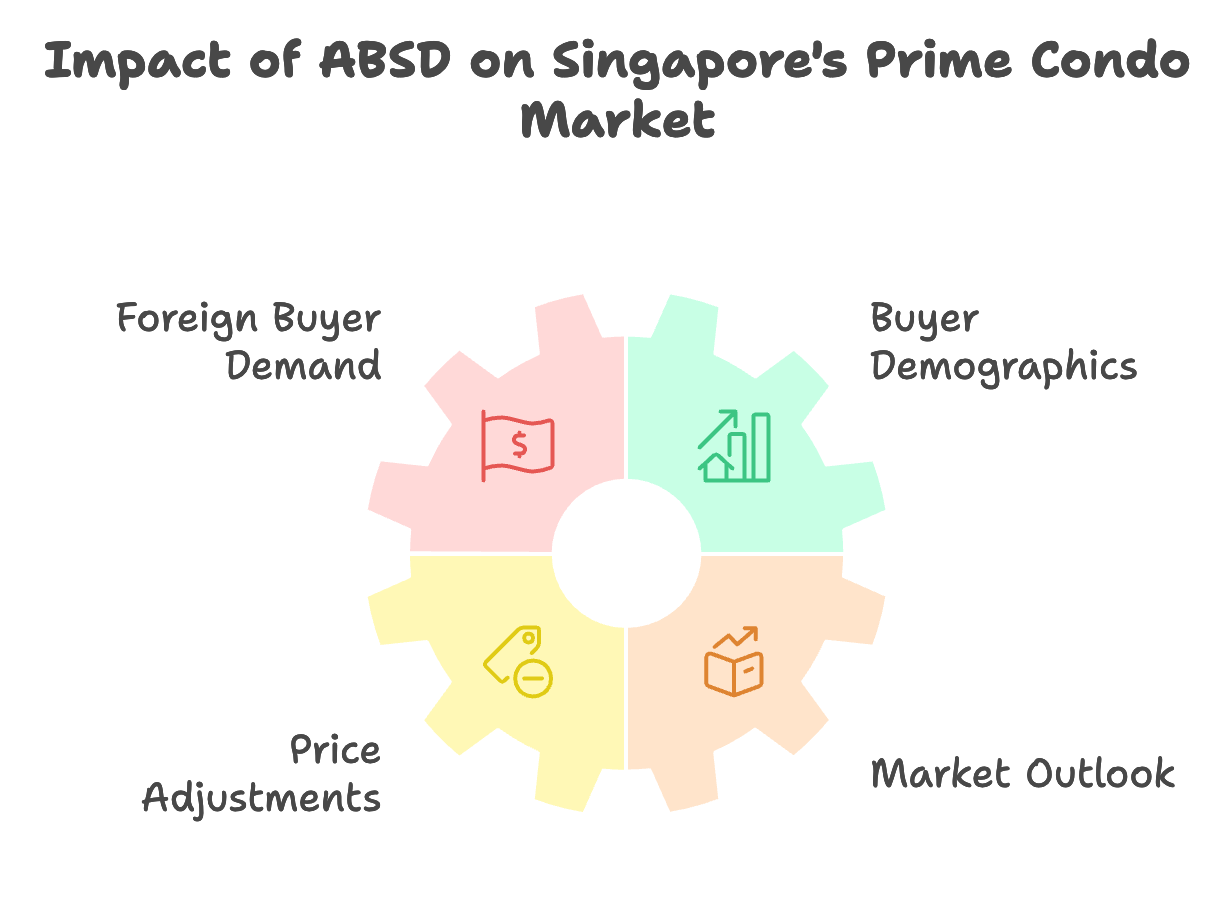
The structural issue is identical: a buyer profile that has not been replaced. Large-format luxury apartments targeting global wealth were priced in the 2009–2013 window when Singapore was actively positioning itself as a family office and private banking hub for Asian high-net-worth individuals. That positioning worked — until it was progressively taxed out of the market, first by the Additional Buyer's Stamp Duty introduced in 2011, then by successive rounds of cooling measures, and finally by the 60% ABSD in 2023.
OUE Twin Peaks (District 9, TOP 2015)
Of 20 total resale transactions in 2025, 19 were unprofitable. One profitable transaction yielded $64,500. The highest loss was $1.002 million. Average price declined 15.3% from 2016 to 2025.
The average psf for the 462-unit development sits at $2,242 psf — below the $2,919 psf some buyers paid at the top. For sellers who entered at peak pricing in a supply-constrained year, the recovery to breakeven requires average prices to climb roughly 30% from current levels.
Marina One Residences (District 1)
The most prolific loss-maker among all Singapore condos in 2025 by volume. Average price declined 19.9% from 2018. One transaction involved a loss of approximately $1.155 million.
The Pattern Across All Four
These are not poorly located projects. These are not developments that missed the MRT or chose bad developers. They are all in the CCR, well-connected, built to quality standards. What they share:
- All purchased near price peaks (2011–2015)
- All dependent on a foreign/international buyer pool that has since been taxed away or deterred
- All leasehold (or structurally disadvantaged for domestic upgrader demand)
- All lacking primary school proximity — the single most reliable domestic demand anchor in Singapore
Why CCR Underperforms: The Structural Mechanics
Understanding the why is more useful than cataloguing the losses. There are five interlocking reasons.
1. The Foreign Buyer Dependency Trap
CCR's historic premium was substantially built on foreign demand — particularly from mainland Chinese, Indonesian, and Malaysian high-net-worth buyers treating Singapore prime real estate as capital preservation or regional base. At peak, foreigners accounted for approximately 14% of CCR condo sales in the 12 months before April 2023.
After the ABSD hike to 60%, that share fell to approximately 5–6%. In absolute terms, foreign purchases dropped from around 1,064 units annually to 306 units in the 12 months post-hike. Only 378 new CCR homes were sold in all of 2024.
The replacement buyer pool — local Singaporean households — has a fundamentally different set of priorities. They need school proximity. They need quantum efficiency (value per dollar of absolute price). They need unit sizes suited to family living rather than investor-grade 1-bedders. Many older CCR projects were not designed with this buyer in mind.
2. The Decentralisation of Singapore's Economy
The Singapore government has been systematically developing regional employment hubs — Jurong Lake District, Tampines Regional Centre, Woodlands Regional Centre, Punggol Digital District — for over a decade. Combined with the expansion of the MRT network across the OCR, the economic rationale for paying a significant premium to live in the CBD has weakened.
This matters for CCR because much of the "location premium" was a commute premium. When the commute advantage narrows, the premium compresses.
3. The Quantum Problem at Resale
An older CCR 2-bedroom at $2,200 psf, sized 700 sq ft, costs $1.54 million. A new-launch OCR 3-bedroom at $2,200 psf, sized 1,000 sq ft, costs $2.2 million. The CCR buyer is paying $1.54M for less space, older fixtures, and a declining lease. The OCR buyer is paying $2.2M for more space, brand-new finishes, and a full lease. For the domestic upgrader making the most significant financial decision of their life, that comparison is not close.
4. Lease Decay Is Now Priced Into Bank Valuations
As leasehold CCR projects age past the 20-year mark, banks begin applying more conservative LTV ratios that reduce the maximum loan quantum for buyers. Fewer eligible financed buyers means a thinner market, which means longer holding periods for sellers and downward pressure on transacted prices. This is a mathematical certainty, not a market sentiment issue.
5. The ABSD Second Property Hike Compressed Local Investor Demand
In April 2023, ABSD for Singapore Citizens buying a second property increased from 17% to 20%, and for PRs from 25% to 30%. The CCR investor segment — locals buying pied-à-terres or investment units in prime districts — was directly hit. The combination of higher acquisition cost and weaker rental yield (as CCR supply builds) compressed the investment case materially.
OCR and RCR: What the Other Side of the Data Shows
The contrast with OCR and RCR performance over the same period is important for context — not to dismiss CCR, but to understand why capital has rotated.
OCR notables (2025 data):
- Treasure at Tampines, Parc Esta, High Park Residences: near-zero unprofitable transactions, annualised capital gains of 4–5.3%
- Average gains for OCR resale condos from 2014 to 2025: approximately 39%
- In July 2025, OCR volumes represented 50.5% of all condo resale transactions vs 16.9% for CCR
RCR:
- Average gains from 2014 to 2025: approximately 26% — below OCR but significantly above CCR
- JadeScape (D20, launched 2018 at ~$1,700 psf) now trading at $2,293 psf average — a 35% gain over 7 years
- AMO Residences: sub-sale transactions confirming $300K–$500K gains from its 2022 launch
The structural explanation is straightforward: OCR and RCR demand is driven primarily by domestic buyers — HDB upgraders, young families, dual-income households. This demand pool is large, growing (fuelled by HDB resale price appreciation unlocking equity), and relatively ABSD-insulated. It does not evaporate when a foreign buyer tax changes.
Will CCR Recover? The Honest Probability Assessment
This is the question that matters most for anyone holding CCR property or considering entry.
The case that it will recover — and is beginning to:
There are genuine signals of improvement at the top of the market in 2025–2026. New CCR launches — The Robertson Opus, UpperHouse at Orchard Boulevard, Aurea, River Green — are selling from $2,750–$3,000+ psf with respectable take-up. CCR recorded 8.28% year-on-year price growth in Q3 2025 — its strongest quarterly performance in years.
Knight Frank explicitly noted that "with a narrowing price gap between prime locations versus the rest of the island, value opportunities could emerge for the observant homebuyer." When OCR prices rise to $2,100–$2,700 psf and CCR entry prices begin at $2,750 psf, the premium for a prime address narrows to a point where some buyers will rationally shift.
Additionally, Singapore's positioning as a global family office and wealth management hub has not disappeared — it has merely been taxed. If macro conditions shift (ABSD recalibration under certain FTA provisions, increased global wealth flows to Singapore), foreign demand could partially return to the upper end of the CCR.
The case that recovery will be slow and uneven:
Recovery will not be uniform across CCR. There is a significant difference between:
- New CCR launches at current developer pricing ($2,750–$3,000 psf): these reflect today's construction costs and land prices. They are priced for current market conditions and will find buyers at the right absolute quantum.
- Resale CCR projects that peaked in 2011–2015: these face a structural ceiling. For a seller at The Clift who needs to recover $2,730 psf from a buyer willing to pay $1,677 psf today, "recovery" requires the average price to rise approximately 63% from current levels. That does not happen in 5 years. It may not happen before the lease concern overrides the price trajectory entirely.
The projects most at risk of continued loss-making are: ageing leasehold CCR developments bought at 2011–2015 peak pricing, especially those with no nearby primary school, no MRT integration, and high concentration of small (sub-700 sq ft) units that have no domestic upgrader appeal at current quantum.
The projects most likely to recover: larger-format CCR units (3-bedroom and above) in freehold or long-remaining-lease developments with school catchment and genuine lifestyle differentiation — think Nassim, Holland Park, Ardmore, or newer launches at the quality tier.
The 3 Questions to Ask If You Are Considering CCR in 2026
Question 1: Are you buying new launch or resale — and does the project have domestic demand anchors?
New CCR launches at 2026 pricing reflect current market clearing levels. Resale CCR projects priced off 2011–2015 acquisition costs carry a very different recovery trajectory. Before entering any CCR resale, check: remaining lease, school proximity within 1km, MRT walking distance, and how many recent transactions have been profitable vs loss-making.
Question 2: What is your actual hold period — and does the lease math work?
Leasehold CCR projects under 80 years remaining on the lease will face progressive bank LTV haircuts that reduce your future buyer pool. If your target exit is in 10+ years on a project now at 77 years lease (like The Clift), your buyer in 2036 will face financing constraints you do not face today. Price that in before you buy.
Question 3: Are you buying for lifestyle or investment — and are you honest about which?
There is a legitimate case for buying CCR for lifestyle: proximity to the CBD, specific school clusters (Anglo-Chinese, St. Joseph's, Raffles Girls'), access to Orchard amenities, prestige of address. If that is your genuine motivation and you can hold comfortably for 10+ years, a well-selected CCR freehold property at 2026 entry pricing is defensible.
If you are buying CCR primarily as an investment expecting capital appreciation to match OCR performance, the 15-year data does not support that expectation under current conditions. Be honest with yourself about which category you are in before you sign the option.
Who Should Consider CCR — And Who Should Not
Strong fit:
- High-income households genuinely working in the CBD who value a short commute and are buying for owner-occupation with a 10+ year horizon
- Freehold property buyers who understand that freehold CCR commands a genuine tenure premium that leasehold OCR cannot replicate — especially for inter-generational wealth transfer
- Buyers targeting the genuine top of the CCR (Nassim, Ardmore, Cuscaden) at the right entry price, with a long hold, treating the property as capital preservation rather than capital growth
- Buyers entering new CCR launches at developer pricing in 2026 — where the psf premium over OCR has narrowed enough that the address upside is not purely aspirational
Not a strong fit:
- Buyers targeting older leasehold CCR projects at above-market psf hoping for recovery to peak pricing — especially sub-80-year remaining lease
- Investors expecting CCR to outperform OCR on 5–10 year capital appreciation — the 15-year data argues strongly against this expectation without a fundamental shift in foreign buyer ABSD policy
- HDB upgraders whose primary motivation is maximising capital growth per dollar deployed — OCR and selected RCR projects have a stronger historical case for this buyer profile
The Bottom Line: What the Losses Are Really Telling You
The losses at The Clift, Marina Bay Suites, OUE Twin Peaks, and Marina One Residences are not evidence that prime property is a bad investment. They are evidence that entry price, buyer profile dependency, and lease trajectorymatter more than address prestige.
Every seller booking a $800,000 or $2 million loss at a CCR condo bought this at some point at a price that seemed reasonable — even smart. The buyers in 2011–2013 were not foolish. They were buying into a genuine demand cycle that subsequently reversed when the structural supports (foreign buyers, cash investors, buoyant rental yields) were systematically removed by policy.
The lesson is not "avoid prime property." The lesson is: understand who the next buyer of your unit will be, at what price, under what financing conditions, and with what motivations — before you commit. If you cannot clearly describe the buyer profile for your exit in 10–15 years, you are not investing. You are hoping.
For CCR in 2026, that buyer profile is becoming clearer again: local, domestic, lifestyle-motivated, well-capitalised, attracted by a narrowing price gap with OCR. That is a healthier buyer base than the speculative investor pool of 2011–2013. Whether it is strong enough to drive sustained price recovery — particularly for ageing leasehold projects — depends on how quickly the ABSD ecosystem shifts and how robustly Singapore's economic growth trajectory sustains domestic income growth.
Those answers are not yet written. But you can make a more informed bet by understanding the mechanics, not just the marketing.
Thinking About CCR, RCR, or OCR for Your Next Property Move?
Trying to decide whether a prime address justifies the premium — or whether OCR or RCR makes more sense for your upgrade?
I'm James Ong, CEA-licensed property consultant with PropNex Realty. I work across all three regions with buyers who are making one of the most consequential financial decisions of their lives. My approach is the same regardless of the price point: understand the buyer profile for your exit, not just the seller narrative at entry.
For this specific question — CCR vs RCR vs OCR — I can walk you through:
- Side-by-side capital growth comparison for your specific budget, using actual URA transaction data for comparable projects over 10-year holding periods
- Lease decay impact modelling for any leasehold project you are considering
- School proximity mapping for your target districts — so you know which addresses have structural domestic demand floors versus which are dependent on cyclical buyer pools
WhatsApp me at 91111173. Tell me your budget and your target holding period — I'll show you where the data points and where the risks sit.
Sources: EdgeProp Singapore, "Is it a Good Deal?: A condo in Downtown Core sold at a loss of $815,769," March 19, 2026 | EdgeProp Singapore, "Lessons learnt from last year's most unprofitable condos," January 13, 2026 | EdgeProp Singapore, "Is it a Good Deal?: A four-bedder in Downtown Core sold at a loss of $2.057 million," June 2025 | Knight Frank / Global Property Guide, Singapore Residential Property Market Analysis Q3 2025 | SRX Property Flash Report, July 2025 | StackedHomes, "These Resale Condos Were the Top Performers in 2025," January 7, 2026 | SG Property Detective, CCR vs RCR vs OCR 10-Year Price Growth Analysis | The Straits Times, "Condo sales to foreigners down 71% since ABSD hike," 2024 | Savills Singapore Residential Sales Briefing Q4 2024 | UOB Global Economics & Markets Research, Outlook 2026, January 15, 2026
James Ong | CEA Reg No. R008385F | PropNex Realty Pte Ltd This article is for informational purposes only and does not constitute financial or investment advice. Past transaction data does not guarantee future performance. All figures sourced from publicly available records as at March 2026.