5 Questions Every Singapore Home Buyer Must Answer Before Signing Anything (2026)
Most Singapore buyers commit $800K–$1.5M without answering the 5 questions that actually determine if the purchase works. Budget ceiling, ABSD exposure, timeline, purpose, location trajectory — get these right before you sign anything.

You are about to commit $600,000 to $1.5 million — and most Singapore buyers walk into that decision without answering the questions that actually determine whether the purchase works.
Not "does this unit have a good view." The structural questions underneath that. Here are three things most buyers never resolve before they sign:
1. They confuse what they can afford with what the bank will actually lend them — TDSR changes that number fast. 2. They forget a second property triggers 20% ABSD for Singapore Citizens — on the full purchase price, in cash. 3. They evaluate a location on current price without knowing whether the upside is ahead of them or already behind them.
This guide covers all five. No agent jargon — just the mechanics and the data.
What Is Your Real Borrowing Limit? (Not Just What You Think You Can Afford)
MAS regulations set two hard ceilings on every Singapore property loan.
The TDSR caps your total monthly debt obligations — mortgage, car loan, credit cards, everything — at 55% of gross monthly income. If you earn $10,000/month and carry a $1,200/month car loan, your maximum mortgage payment drops to $4,300 — which on a 25-year loan at 4% translates to roughly $825,000 in loan quantum, not the $1.1 million your income alone might suggest.
The MSR applies only to HDB flats and Executive Condominiums. It caps your mortgage payment at 30% of gross monthly income — a tighter constraint than TDSR for most upgraders.
| Rule | Applies To | Cap |
|---|---|---|
| TDSR | All residential property | 55% of gross monthly income |
| MSR | HDB and EC only | 30% of gross monthly income |
Source: MAS Residential Property Loan Rules, revised 2023.
James's Note: The TDSR is the number that resets buyer expectations fastest. I've seen clients earning $12,000/month discover their real loan quantum is under $900,000 because of a car loan they'd stopped thinking about. Run your full debt picture first — then set your property budget. Doing it backwards is the most common and most costly sequencing error I see.
Is This Your First Property? ABSD Changes Everything for the Second
ABSD is levied on top of standard Buyer's Stamp Duty based on your residency status and number of properties owned at purchase.
| Buyer Profile | 1st Property | 2nd Property | 3rd and Beyond |
|---|---|---|---|
| Singapore Citizen | 0% | 20% | 30% |
| Singapore PR | 5% | 30% | 35% |
| Foreigner | 60% | 60% | 60% |
Source: IRAS ABSD Rate Table, updated 2023. Current as of March 2026.
On a $1.2 million second property, ABSD for a Singapore Citizen is $240,000 — payable within 14 days of the OTP being exercised, in cash.
The Decoupling Option is one strategy married couples consider: one spouse takes sole ownership of the existing HDB, freeing the other to buy private property as a "first-time buyer." This is legitimate but involves conveyancing costs, requires HDB approval for HDB flats, and has been structurally constrained by MAS rule changes in 2023. Get proper legal advice before assuming it applies cleanly.
See also: ABSD on Your Second Property in 2026 — What the Full Cost Actually Looks Like
Personal Home or Investment? The Goals Are Structurally Different
✅ Buying as a home: Location to school, MRT, family matters. Floor plan liveability, orientation, noise — things a tenant tolerates that a resident cannot. Capital appreciation matters over 10–15 years, not 3–5. Emotional fit is a legitimate factor.
✅ Buying as investment: Gross and net rental yield after maintenance and sinking fund. Tenant demand drivers — proximity to CBDs, expat schools, MRT. Exit liquidity. Emotional fit is a distraction — buy what tenants want, not what you'd choose.
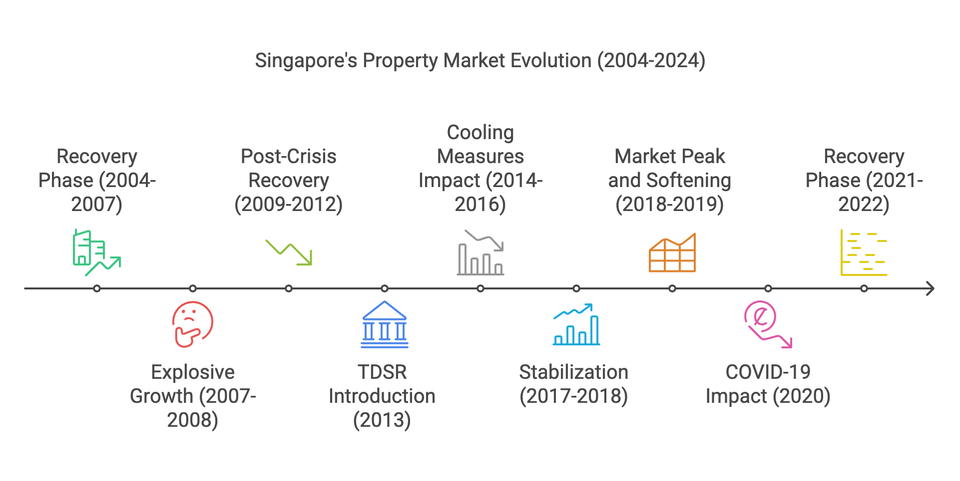
Singapore's private residential index has gained for nine consecutive years — approximately 3.4% in 2025, following 3.9% in 2024 and 6.8% in 2023 (URA, Q4 2025). But aggregate index performance masks significant divergence at the project level. A correctly priced, well-located unit outperforms the index; an overpriced or poorly tenanted one underperforms even in a rising market.
What Is Your Real Timeline? New Launch vs Resale Is a Time Decision
A typical Singapore new launch takes 3 to 4 years from OTP to TOP. During that window you are paying progressive payments, you cannot move in, and rental income is zero. If you need to sell your HDB before TOP, your planning horizon becomes tight. Have you factored rental costs for the gap period into your total acquisition budget?
A resale private property gives immediate possession — typically at a premium, especially in supply-constrained districts. For upgraders whose MOP is already met, removing the timeline gap entirely has real financial value.
❌ Buying a 3-to-4-year new launch with an unclear personal timeline is the highest-friction combination in Singapore property planning.
James's Note: The question I ask every upgrader client is: "What is your rental plan for the gap period?" Some clients are fine renting for 3 years because they believe strongly in a location. Others have school enrollment timelines that make a 4-year wait genuinely problematic. Know your constraint before you fall in love with a showflat.
See also: Renting in Singapore 2025 — What It Really Costs HDB Upgraders
Is This Location Still Gaining — Or Has It Already Peaked?
Singapore's market is hyper-localised. District-level price movements diverge meaningfully from the URA All-Private Index. Three signals worth checking for any location you are serious about:
1. URA Master Plan Land Use Zoning. Land zoned for future residential development means future competing supply — which compresses yield and resale liquidity. Land zoned for green buffer or civic use constrains supply permanently.
2. Confirmed MRT completions. Station openings typically drive appreciation in the 2–3 years before opening (expectation phase) and 1–2 years after (realisation phase). Check the LTA forward construction map.
3. Transaction volume, not just price. Falling volumes even as prices hold signals thin liquidity — sellers are holding but buyers aren't clearing. That is a yellow flag for exit risk.
See also: District 26 Landed — Why Upper Thomson and Springleaf Are the Quiet Trade of 2026
The 3 Questions to Ask Before You Exercise the OTP
Is the MCST financially healthy?
Request the latest AGM minutes and financial statements before you commit. Check the sinking fund balance against the age and condition of the building. A sinking fund significantly below the recommended contribution level means a special levy — an unplanned cash call — is likely.
Why is this unit priced this way?
A unit below comparable transactions is not automatically a bargain. It may reflect a facing or floor disadvantage, deferred maintenance, tenant complications, or a poorly-run estate. Understand the discount before you celebrate it.
Can I exit this cleanly if circumstances change in 5 years?
Check transaction volume in the development over the last 12 months. Low volume means low buyer competition if you need to sell — which compresses your negotiating position at exit.
Who This Applies To — Strong Fit vs Weaker Fit
Strong fit to act now:
- MOP met, TDSR clean, no ABSD exposure — buying window is open
- Confirmed life event in 12–18 months creating genuine housing need
- Target location has confirmed infrastructure catalyst not yet fully priced in
- Investor with clear 8–10 year hold horizon and identified tenant demand
Weaker fit — plan further first:
- ABSD exposure on second property with no clear strategy to absorb it
- MOP not yet met — rushing before MOP forfeits the HDB sale proceeds that fund your downpayment
- TDSR tight due to existing debts — pay down the car loan first
- No clarity on personal timeline — a new launch is the wrong product
Bottom Line
Singapore's property market has delivered nine consecutive years of price gains. The structural demand drivers — rising incomes, strong household formation, flush liquidity, and a land-scarce city-state — remain intact in 2026, even as GDP growth moderates from 4.8% in 2025 to a projected 2.6% (UOB Research, January 2026).
That does not mean every purchase is a good purchase. The five questions in this guide are the filter between buying well and buying expensively. Answer them honestly before you walk into a showflat — not after you've already fallen in love with a unit.
The best property decision is not the most exciting one in the showflat. It is the one that still makes sense when you run all five questions against the real numbers.
Want to run these 5 questions against a property you're currently considering?
I'm James Ong, a CEA-licensed property consultant with PropNex (CEA Reg No. R008385F). I work with HDB upgraders, EC buyers, and investors navigating Singapore's private market — helping clients stress-test their shortlist before they commit.
My background goes beyond transaction advisory: I spent years managing residential estates from Executive Condominiums to ultra-luxury developments as a Managing Agent. When I review a property for a client, I check what most agents never look at — MCST sinking fund health, deferred maintenance exposure, and estate governance quality.
WhatsApp me at 91111173 — bring your shortlist of 2–3 properties and I'll walk you through the full framework: TDSR position, ABSD exposure, and a location trajectory read on each option. No pitch. Just the mechanics.
Sources: URA Private Residential Property Price Index Q4 2025 · MAS TDSR/MSR Rules (revised 2023) · IRAS ABSD Rate Table 2023 · UOB Global Economics & Markets Research, Outlook 2026, January 2026 · HDB/CPF Housing Usage Guidelines
James Ong | CEA Reg No. R008385F | PropNex Realty Pte Ltd. This article is for informational purposes only and does not constitute financial or investment advice.